Kickdown

Kickdown / Rebecca Clarren / Arcade Publishing / 2018

As shameful as it is to confess, the first time I listened to Tracy Chapman I couldn’t relate. I may have been in high school or in the sophomoric years of undergrad, where part of me knew I had suffered more than most of my peers and believed it made me special. I definitely suffered more than some, but I had suffered nowhere near as much as I thought I had and it certainly did not make me special. My young self only wanted kicks and snares to treat my eardrums like punching bags. I wanted punchlines to uppercut my guts. There was so much I couldn’t hear in the nuance of a voice, in the careful fingering of a guitar, in the silence. Thankfully, I would later return to Tracy Chapman’s work with a clearer, if wetter, eye.

Once, Tracy Chapman’s music played on shuffle during a card ride, and the poet Leticia Hernandez Linares told me to change the track. She wasn’t up for the brewing of that set of emotions. The more I have sat with my own crushed hopes, my own tender and powerless love, the more Tracy Chapman’s music has made sense to me. The more its strings and hums have cut and calmed my wounds.

I feel the same way about Tracy Chapman’s music that I feel about rural America. Once I hated its silence, its slowness, its empty space, its darkness. I wanted to run back to my train-chugging city, its bright lights and slick rhythm. By extension, Kickdown is a novel I’m not sure I would have appreciated when I was young—but I should have. Written by Rebecca Clarren, a prize-winning journalist who reported on environmental issues in the rural West, Kickdown not only provides good material for discussing the politics of oil, water, and rural life, it also provides a penetrating look into the lives of three characters shaped by the classic rural values of self-sufficiency and hard work.

One of the questions Kickdown asks is how do these values fail and reward its main characters. Kickdown follows a pair of sisters, Susan and Jackie Dunbar, and Ray, an Iraq war veteran and police officer, and begins by capturing what certainly can count as some of their bleakest moments. Susan and Jackie have just lost their father and find themselves in the predicament of failing to adequately take care of his enormous ranch and livestock. Early on, Jackie gets ran over by a cow and Susan goes close to losing her mind. Ray, on the other hand, feels stuck in his marriage and drinks to avoid PTSD flashbacks of Iraq. If the book can feel a tiny bit slow at times, that’s because Kickdown is a book about setbacks.

Kickdown.jpg

The novel opens with an impressively detailed description of a cow giving birth, a thrilling scene that shows Clarren did her homework and has earned her rural chops. There are similar moments scattered through the novel that I suspect will make ranchers and rural folk grin with recognition. One of my favorite aspects of the novel includes itsl turns of phrase, such as this nice zinger on page 40: “Shorty Lee has always been a real bee in cheesecake.” All my minor annoyances are now officially bees in cheesecake.

The novel offers this rather jargony definition of kickdown as an epigraph: a well will kick or kick down when the pressure of natural gas overcomes the pressure exerted by the mud column.” This makes sense as the novel rotates around the rippling effect a kickdown can have on a rural community. The result is much more dramatic than the scientific definition implies. A more casual reading of the title, on the other hand, can refer to the state of the main characters—these folks have definitely been kicked down.

What I love most about Kickdown is its tender portrayal of the messiness involved in getting your life back together after a major catastrophe. Each of the three main character have lost their dreams and face the challenge of rekindling their hope against tremendous power and odds, be it the promises they made to their father, the boundaries of a marriage, or the financial and legal strength of the oil industry. Clarren narrates all the action with the clean, cutting eye of a well-seasoned journalist mixed with the flare of a (good) buzzed poet.

I would strongly recommend teaching this book in a class about the rural West, environmental literature, in a creative writing class focusing on perspective or just writing some plain ole strong prose. If you are looking for a book to help you survive a moment that feels like it just upended your life, this book may be for you. 

When the Living Sing / Don't Call Us Dead: Surviving Black Death in the Poetry of Danez Smith and Yalie Kamara

When The Living Sing, Don’t Call Us Dead: Surviving Black Death in the Poetry of Danez Smith and Yalie Kamara

“how long

does it take

a story

to become

a legend?

how long before

a legend

becomes

a god or

forgotten?”

220px-Drake_-_If_You're_Reading_This_It's_Too_Late.png

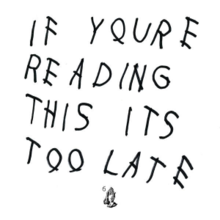
Danez Smith poses us these difficult questions in “not an elegy,” a blistering meditation on survival that confronts the murders and suicides of different Black people. These lines are a direct call-and-response to the epigraph of their sophomore collection of poetry Don’t Call Us Dead (Graywolf Press, 2017). Smith introduces the collection with Drake’s hook on “Legend,” the opening track of his 2015 mixtape “If You’re Reading This, It’s Too Late,” where the Cash Money rapper brags, “Oh my god, oh my god, if I die, I’m a legend.” Smith’s questions pull an awestruck Drake by the collar to interrogate what it actually means to become a legend when you die. ¿What does it mean be at risk of becoming Biggie Smalls or Mike Brown? For Drake, this realization is one of his greatest accomplishments. There’s the pride of knowing you’re a living legend—like Drake, like Danez—dominating the game and knowing your death would be a tragedy; then, there’s the dumbfounded pride and despair of knowing you’re a living legend, dominating the game and knowing your death will be a tragedy and because of the color of your skin, even that won’t save you; those who share your hue will never be afforded that privilege. They will never have their death properly mourned and have that mourning legitimized by the so-called justice system. “what legend did we deny their legend?” Smith asks. ¿What happens when that same legend is mythologized or forgotten? ¿How does it change the way we envision ourselves and, thereby, envision the world?

It is into this screaming assault on the sanctity of Black life that both Danez Smith and Yalie Kamara publish their new collections of poetry. Both collections find complementary, at times opposing, ways to transcend the grief of Black life in the United States. Danez Smith’s collection confronts the consequences of two fatal epidemics, white supremacy and HIV/AIDS, and wrings from their suffering the magnanimity to face the brutal realities of these diseases, as well as the unconquerable ability to imagine and enact a wondrous life within and without them. Yalie Kamara’s debut chapbook When the Living Sing (Ledge Mule Press, 2017), on the other hand, unpacks the rupture she experienced as a first-generation Sierra Leonean-American and finds in song the grace to transform the anguish of Black death and dislocation into the triumphant joy of survival. When I read Don’t Call Us Dead, I long for the bonebreaking joy of Kamara. When I read When the Living Sing, I long for the unflinching frankness of Smith’s eyes surveying his America. I am writing about both these collections together because I cannot read one without hearing the voice of the other harmonize and counterpoint. 

A look at their cover images highlight the resonances in their collections. When the Living Sing is inaugurated by a photograph Kamara took during her time living abroad in France. In it, a graffitied pair of scissors are about to cut free a heart-shaped balloon from its earthly tethers. The pairing of the image with the title implies that when the living sing, we unbind our hearts. By “couper ici” or “cutting here,” we can transcend beyond our worldly worries and limitations. Kamara’s songs are at times cutting and painful, but always, they are life-saving.

The cover image of Don’t Call Us Dead includes a similar image of balloons and flight: “the moment you doubt whether you can fly, you cease forever to be able to do it,” a visceral image by visual artist Shikeith Cathey. Cathey’s work mines the too-often unacknowledged depths of Black masculinity, depicting Black men at their most vulnerable, at times naked, selves. In the cover image, two nude young black men ascend into an off-white sky. The first looks down in the precarious space between fear, reflection, and doubt, holding the delicate string of a black balloon in his left hand and the hand of another young black man in his right. The second looks up (¿hopefully?) to the slightly larger, slightly higher young man. The vulnerability here—the bravery and fear as they dare to do the unthinkable and take flight—is captured by the stark contrast between black and white and the expressive language of their profiles. The title of the image undergirds the entire piece with fear. ¿Will they stay faithful to the possibility of their flight? The title of the image implies that their ability to transcend hinges on something more precarious than “couper ici,” namely the fortitude of their faith to persist in the face of unspeakable odds.  

don't call us dead.jpg

The title of Smith’s collection, Don’t Call Us Dead, stretches the reach of the symbolic lexicon of the cover even further, opening up a slick allusion to the story of the Flying Africans. I first heard about the Flying Africans in conversation with Ross Gay, where he questioned me about the ways myth and metaphor illuminate and/or obscure violence. Igbo people, the mythology goes, survived the Middle Passage and upon reaching the shores of Savannah, Georgia, collectively decided to escape, to fly back home. According to wyt folks, in this case slave owner Roswell King, the group collectively walked into the ocean and drowned themselves to escape the horrors of slavery. According to over 200 years of African American folklore and literary tradition, however, the Igbo peoples flew back to Africa, sometimes as buzzards, sometimes joining hands and spinning in a circle until they rose into the sky and flew away. Like the story of the Flying Africans, the black boys and men that populate Smith’s heavens and earth have their lives denied, defined by their proximity to death; Smith creates in their poems a world where Black folk are given relief from violent death—with or without magic. Like the story of the Flying Africans, the Black folk who populate Kamara’s world find themselves “too beautiful not to be in hiding”; Kamara enacts through her poems a world where song can save us. 

I began this conversation with Smith’s “not an elegy” because it drives at the heart of Ross Gay’s question—¿what is the role of myth and metaphor in illuminating and/or obscuring violence?—and illuminates Kamara and Smith’s differences in responding to other important questions, namely ¿how does one overcome the grief in Black life in the United States? ¿what are the powers of prayer and song? ¿what are the limits? The second section of “not an elegy,” which is a remix of “not an elegy for Mike Brown,” a poem that went viral during the Ferguson riots and resistance in 2014, begins “i am sick of writing this poem,” a line that captured the pain and despair of so many Black writers speaking against police brutality that it has since become a cliché in the Black literary community. We enter this section of the poem with an immediate dismissal and frustration with the limits and redundancy of poetry, which like the courts, are useless in providing violated communities reprieve and justice. Smith rightly escalates the fight by the end of the third stanza, demanding “a war to bring the dead child back. / i at least demand a song. a head.” Here, the surprise is after the nausea felt of yet another Black life lost, of again needing to write the poem, the song, Smith reasserts the value of song and song’s important role in healing, despite the obvious need to ascertain justice for the victims of police brutality from the perpetrators. In the last section of “not an elegy,” Smith laments “i have no words to bring him back, i am / not magic enough.” If this sentiment is expressed with despair, it is not expressed with fatalism. What is so powerful about Smith’s work is that they does not fail to see and recount the devastation before them; they may flail, they may bite and kick and cry, but Smith never surrenders.

On the back cover, poet laureate Tracy K. Smith notes, “Don’t Call Us Dead gives me a dose of hope at a time when such a thing feels hard to come by.”  I’m not sure if hope is the right word. As Danez Smith suggests in a recent Mic50 interview, “to be real, the future sorta sucks. At least the one our collective imagining is leading to. It’s dry, like no water dry, and sad.” Hope is a precious comfort no one wants to abandon. I know because I’ve shouted my grief in the streets as one of the leaders of the sanctuary campus movement in my college town, and I’m now invited to speak at panels on activism and immigration. One of the questions our brilliant, beautiful, and exhausted young never fail to ask is “¿how do you stay hopeful?” We don’t know what we’d do without hope. When I look around my Americas, families torn apart by deportation, all the #metoo statuses by friends, family members, and lovers I have had, the endless list of grievances we share, hope is not what keeps me going. Hope is a poor solution for injustice.

I tell the young students that slavery took hundreds of years to “end” and those who lived under its yoke still fought and dreamed and gave their all to their loved ones. I hustle with no real expectations for change.  I don’t have another word for what propels me personally, but this “little prayer” by Danez Smith feels close:

let ruin end here

let him find honey

where there was once a slaughter

let him enter the lion’s cage

& find a field of lilacs

let this be the healing

& if not   let it be

The final stanza of this poem is the most important in the entire collection for me. What Smith offers us may not be healing, but it is the might and love to bear what we must.

While Smith’s work wrestles against the limitation of word, the limitation of song, Kamara’s entire collection is premised on capturing what does happen when the living sing. The chapbook opens with the Sierra Leonean proverb, “The song is done, the words remain,” a koan that dares me to believe we can live in song, in the healing and the emotional purity and beauty of it, that the words remain with us for a reason. Words are not just the dead bones of a song, the same way the bones of our loved ones are not just bones. In “Aubade For Every Room In Which My Mother Resides,” the first poem of the collection, Kamara listens to her mother’s singing, perhaps similar to Smith and definitely similar to myself, as a skeptic:

Before I knew her wail was a blues ballad,

I called her croon crazy. Thought this

a song I could do nothing with.

The youth in Kamara speaks with an arrogance the rest of the poem humbles and unravels. This is a powerful choice because the rest of the poem enacts for us the process of observing her mother pray and sing and then, Kamara praying and singing herself. “I am ready,” Kamara tells us halfway through the poem, and by the end, she is spelling her name in her throat, which is to find your identity, your inner strength. For Kamara, this is done by entering pain and expelling not the pain itself, but the root:

This is how she beckons me to hold this life,

with both hands, even when it aches like a

word shunted in bone.

I walk toward the sound of splinter exiting kin.

Dawn is peeling from dusk. And my mama

is teaching me how to depart from that

which does not love us.

Note: I always read this first poem backwards because I am not brave enough to read it forward. In reverse, each of the sections build to tell a story of betrayal of the mother’s heritage and a lack of access to prayer. Read forward, the right way, the reader is brought to their knees in prayer by the first poem of the collection. Kamara blesses you with “lungs that eat crystal”. The power to “make rubble sing”.  

While Smith cries “i have no words to bring him back, i am / not magic enough,” in “Resurrection,” prayerful words of the Kamara clan perform a miracle. The poem chronicles the grief of Kamara’s family as they mourn the loss of the writer’s grandmother. Kamara bears witness to a visitation by the grandmother who visited them by night and partook of a dinner offering left to her by her children. “The dead only die when the living refuse to sing for them,” Kamara teaches us and thus, presses into our hand the delicate balloon string of miracle, the power to keep our loved ones close to us, almost as if they were alive.

And therein lies the tension that makes me hug both of these collections tight, the racquetball in my brain as I struggle to find my way out of my particular despairs and grief. My hand is clenched tight as a vice around the string of a balloon, and I’m not sure whether it’s confidence or fear, faith or doubt.

The power of Kamara’s work is that she knows how to read the darkness, and in it, find beauty, resilience and light. In “Oakland as Home. Home as Myth,” Kamara combats negative rhetoric that attempts to reduce Oakland to a bullet-ridden “killing field,” flattening the lives of those who live and love and find joy in the city. She tells us,  

            We are the bucktoothed city that made you wish you

            never wore braces…

We fall and get back up again and tell you that we didn’t mean to make our

          mistakes look like a dance. All that big booty attitude in those small Bay

                        Area jeans…

To claim this is a city of endless nightfall is easy. If they knew how to read darkness

they would have figured it out by now:

the object that casts the biggest shadow is the one closest to the light.

Compare this with Smith’s beautiful poem “tonight, in Oakland,” where he fantasizes that “tonight / guns don’t exist. tonight, the police / have turned to their God for forgiveness… tonight, prisons turn to tulips / & prisoner means one who dances in yellow field.” Here, Smith’s spirit must transform reality to achieve freedom and reclaim Oakland, while Kamara manages to root this joy in Oakland’s reality. Whereas in Smith’s world Black men and boys must die to call snow black, whereas in Smith’s reality even the Black guy’s profile reads sorry, no black guys, in “Sweet Baby Fabulist,” Kamara shares the story of how her three-year-old nephew calls everything he loves, everything that is beautiful Black.

It’s not that Smith’s reality doesn’t have its share of celebration, joy, and reclamation; it’s more that Don’t Call Us Dead provides a map for those who don’t always have access to spiritual communities and supportive kinship that Kamara may. In “a note on the body,” Smith guides the forsaken and godless with the words,

when prayer doesn’t work:                 dance, fly, fire

this is your hardest scen

when you think the whole sad thing might end

but you live                 oh, you live


everyday you wake you raise the dead

            everything you do is a miracle

Smith has survived by finding the miracle in the Black boy with his unfloating feet, planted firmly on ground, holding a balloon. The same way James Baldwin reverses the N-word and spins it onto wyt people, throughout Don’t Call Us Dead, Smith fights to undo the stigma and portrayals on queer bodies, on Black bodies, on HIV+ bodies as dying, as dead and spins it on the United States. “You’re Dead, America,” declares Smith in his post-election poem. “Those brown folks who make / up the nation of my heart” are “realer than any god.”

While Smith may indulge in fantasy and myth—even dreaming of becoming a Flying African themself, as in “Dear White America”—their survival relies on building a soul tenacious enough to withstand the heat and explosiveness of White America. If that doesn’t work for you,  follow Kamara’s song and prayer and help her build her New America. Reader, take from both these collections what you need to keep pushing. Take this string. Fly.

Corazones Peludas: Two Dope Collections by Latina poets

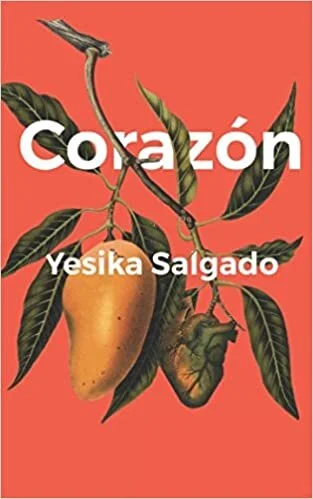
Corazón / Yesika Salgado / Not a Cult Press / October 2017  

Peluda / Melissa Lozada-Oliva / Button Poetry / September 2017

Corazones Peludas: Two Gorgeous Poetry Collections by Centroamericanas

Imagine you are at a slumber party with all of your homegirls, complete with nail polish and cheap booze. Your homegirls give you two options: Would you rather be 1) “completely covered in fur, like, head-to-toe, monster type of shit,” or 2) “perfectly smoothie-smooth in all of the right places: thighs, crotch, armpits, upper lip, neck? But here is the caveat, alright: all of the hair that would have grown in those places takes the form of a tail.”

Peluda.jpg

Melissa Lozada-Oliva poses the reader this question and many more in her debut collection of poetry, Peluda (Button Poetry, 2017). On the front cover, the nightmarish image of Lozada-Oliva’s slumber party monster repeats on a daffodil-yellow background. If this hairy monster is comical or absurd, it is also an accurate portrayal of the monstrous ways American culture distorts the bodies of women who fail to uphold its rigid guidelines. The hairy monster is an externalization that perfectly symbolizes the anxieties many Latinas face. At the end of the slumber party poem, the speaker’s woke friends dismiss her party question, focusing instead on self-love and acceptance of their body hair; meanwhile, the speaker confesses, “I always choose the tail,” a heartbreaking, if silly conclusion to the game. Lozada-Oliva’s ability to balance whimsical humor with breathtaking disclosure is what makes her poems so magical. Lozada-Oliva deftly navigates Latina identity with a brutal playfulness, an undeniably addictive rhythm and punctuation that squeals and screams, giggles and sobs off the page.

As if in call-and-response to Peluda, Yesika Salgado published Corazón (Not A Cult, 2017), her debut collection of poetry. Corazón chronicles the poet’s journey through heartbreak and romance to self-love. Whereas Lozada-Oliva’s voice is unapologetically girly and visceral, Salgado strikes the page with a gut-dropping honesty and introspection. I am not sure how exactly Salgado would respond to Lozada-Oliva’s slumber party question, but in Salgado’s poem, aptly titled “Peluda,” she reveals the way our culture’s policing of hair has infected her relationships:

I used to leave your house before we fell asleep / tell you I had to get home before work the next morning…

The night sprawled out before me as I made my way home / to the razor blade in my shower / the hair on my chin growing / a hundred little fingers ready to give me away / ready to show you I am not the woman you think I am / that sometimes I am grizzly / manic / human

one day / I didn’t leave / you said love / I believed it / the sun found me and my bearded chin in your kitchen / stirring oatmeal / your hands on my waist / a soft song saying / so this is what it means to stay

Salgado’s poems have the preternatural ability of capturing the smallest domestic moments and excavating their emotional core. Her poems demonstrate the power of vulnerability, its ability to make love possible and heal wounds.

Peluda and Corazón are both poetry collections by Latinas whose bodies are under intense scrutiny—for their color, for their hair, for their size. They plunge their reader through the conundrums of contemporary Latina identity, a maze of mirrors where the authors’ immigrant heritage and self-perception are disfigured by the male gaze and xenophobia in America. A side-by-side reading of these collections reveals not only the common struggles shared by these two young Latina writers, but also the complimentary, if at times opposing, strategies for coping with the pressures of America’s beauty standards. In a culture that attempts to reduce Latinas to housekeepers and sexual objects, Melissa Lozada-Oliva and Yesika Salgado write poetry that demonstrates the complexity and range of Latina identity in the 21st century. Far from the flat portrayals of pan-Latino characters common in the mainstream, Lozada-Oliva (a Guatemalan-Columbian American) and Salgado (a Salvadoran American) unflinchingly unpack their fraught relationships to their Latinx backgrounds, to their bodies, and to men.

Both poets pay special attention to the ways destructive behaviors are passed down one generation to the next. In these moments, they reveal intergenerational trauma and reveal the work it takes to heal. In “Traditions,” Yesika Salgado parallels her mother’s response to her father’s misdeeds to her own response to her partner’s misbehaviors. When their men ask questions stemming from insecurity and guilt—such as “we are happy, aren’t we?” or “you’ve forgiven me, right?”—both Salgado and her mother fail to rebuke them or respond frankly. Rather than tell the men “the everything of everything,” Salgado responds with a tearful nod. The love and commitment Salgado and her mother have for their men overpowers their need to hold them accountable in this moment. The moment is filled with risk: Do I suffer in silence or do I upset this gentle moment? Can I let go of my hurt and resentment? Will things work out? Fear of the unknown, of loneliness, of being unloved, of fighting again and worse charges these pages with an explosive energy. In “Traditions,” Salgado chooses the path of her mother and refuses to spark the fuse—for now. The poem raises questions about the soundness of this choice, foreshadowing the rise of a speaker who will soon find her strength to demand more from her partners.  

In “I Shave My Sister’s Back Before Prom,” on the other hand, Lozada-Oliva describes how her sisters inherited hair from their father and fear from their mother. Here, the father not only works with the mother to police their appearance and behavior, he also gives them the physical trait that prevents them from fitting in. “maybe this has always been about our parents & all the things we never told them & all the ways they made us different,” Lozada-Oliva laments before shaving her sister’s back. Shaving, in the poem, becomes a celebrated act of rebellion, paralleled with their sneaky choice to stay up past their curfew.

Beauty routines accrue meaning throughout Peluda until they ultimately become redefined as acts of resistance. This move is crystallized in the last poem “Yosra Strings Off My Mustache Two Days After the Election in a Harvard Square Bathroom,” where the speaker declares, 

this isn’t oppression. this is, i got you.

i believe you. it hurts but what else are we going to do

it aches but we have no other choice do we

Beauty routines become rituals of love and self-love, where community and support are found. Lozada-Oliva knows she cannot escape oppression. She cannot heal all the wounds. The years of shame cannot be undone, but throughout Peluda, Lozada-Oliva overcomes shame by outperforming it, by beating it at its own game. 

If Lozada-Oliva and Salgado appear to be obsessed with hair, this compulsion is the result of living in communities so ready to attack them for any stray strand. In Salgado’s “Hair,” for example, the poet remembers, “you’d complain / about my hair. / how you always / found it in my sheets / after I’d gone home.” Stray hairs are often viewed as disgusting or annoying, but in the post-break-up phase of “Hair,” where the poet is suspicious of their ex’s infidelity, hair also becomes evidence of their relationship, and in turn, possible evidence of an affair to another woman. This realization raises suspicions about the motive behind the ex’s complaint, compounding the emotional weight granted to stray hairs.

Similarly, in “My Hair Stays on Your Pillow Like a Question Mark,” a white girl (Lozada-Oliva’s phrase, not mine) criticizes the speaker for leaving behind hair at her apartment. Almost the entire poem is end-stopped with double question marks, signaling the insecurity sparked by the white girl’s criticism and littering the poem all over with hair. Hair, as we know from “I Shave My Sister’s Back Before Prom,” becomes a symbol of Lozada-Oliva’s heritage, so in the poem, the white girl’s disgusts makes Lozada-Oliva insecure not just about her appearance, but her heritage:

imagine your hairs as daddy longlegs

crawling up the shower curtain??

daddy’s long legs??

daddy’s dark legs??

daddy’s hairy dark legs??

imagine you are what makes the white girls in a brooklyn

apartment scream??

except deep down?? you want to be a white girl

in a brooklyn apartment??

In these poems, hair has the power to define and literally create its bearers. Here, it transforms Lozada-Oliva into a spider, then her father, both of whom are terrifying and inhuman to the white girl in Brooklyn.

Like their relationships to their hair, their relationships with their homelands are equally fraught. In “Jenny and I” and “My Salvadoran Heart,” Salgado pushes past the clichés of homeland nostalgia to create a striking parallel between her longing for a homeland and her longing for a lover. As the first two poems of the collection, these poems become a sort of ars poetica, a map with which to read the poet’s journey through love and heartbreak. In “Jenny and I,” the mango is established as a place marker for El Salvador, and El Salvador is described romantically as “that country we considered wild / all that green / all those animals.” Salgado’s front cover, designed by Cassidy Tier, shows a heart growing beside a mango on the same branch. For Salgado, “love” is “a dangling fruit I ached to eat.” Similarly, in “My Salvadoran Heart,” Salgado tells us,

I am asked if I want a husband / asked if I will return to my country / they are the same question / I do not want to answer.

The conglomeration of romantic and diasporic longing makes each of Salgado’s love poems about more than heartbreak and love; they also become about having a difficult relationship with home and homeland. This understanding reveals deeper layers to poems like “Motherhood,” where the poet asks her lovers “aren’t I a home, baby?”—another question that rarely has an easy answer. Salgado’s question is not only about romance.

The way Salgado’s Salvadoran background becomes inseparable from her love life becomes inseparable from her own body image becomes inseparable from her parent’s relationship is mirrored in Lozada-Oliva’s “You Know How to Say Arroz con Pollo but Not What You Are.” In this poem, Lozada-Oliva unpacks her relationship to Spanish, and in the process, winds up narrating her parent’s romantic relationship and divorce. Lozada-Oliva ends the poem on lines about longing and distance:

i will tell you my Spanish is understanding that there are stories / that will always be out of my reach / there are people / who will never fit together the way that i wanted them to / there are letters / that will always stay / silent / there are some words that will always escape / me.

Lozada-Oliva’s Spanish is like Salgado’s mango—out of reach, escaping her. The last line break, however, implies a reversal in this relationship. My Spanish is me, the last line implies, suggesting this tangled relationship with love, language, and family history is, in fact, inescapable. Likewise, the break at “stay” implies there are words that always stay and also words that are always silent. 

Don’t let these troubled relationships make you believe everything these women receive from their heritage are stumbling blocks, however. Poems like “Los Corvos” and “The Women in My Family are Bitches” showcase the strength and wisdom these poets draw from the women in their families. In “Los Corvos,” Salgado’s machete-wielding matriarchs not only become role models of physical strength, but also the emotional strength it takes to draw boundaries and let go of toxic people. “I come from women who know how to fend for themselves,” Salgado tells us. “the blade is our friend. / and you? / you are a weed. / I know how to slice you out of me.” In “The Women in My Family are Bitches,” Lozada-Oliva proudly portrays the women in her family as “cranky” and “stuck up,” but if anything, Lozada-Oliva’s reclaiming of “bitch” reconstitutes the word to make it encapsulate the women in her family in all their complexity. If the women in Lozada-Oliva’s family are bitches, they’re the bitches who ask you to “give abuelita bendiciones!” They’re the bitches who worry about you enough to ask you to pray before the plane takes off and text them before you get home. Most importantly though, both Lozada-Oliva and Salgado’s women kin believe in a self-autonomy that will cut off those who betray them.

Peluda and Corazón both show us different ways of grappling with the pressures of Latina identity. While Lozada-Oliva finds power in converting beauty regimens into rituals of resistance, Corazón traces the arc of heartbreak and demonstrates the ways vulnerability makes love possible, even after heartbreak. “all of my poems are collection plates,” Salgado declares. “I fill / and fill / and fill / and fill / and / fill / I have yet to come up empty.” If you explore these collections, reader, neither will you

Teaching Statement

My experiences in academic and community workshops have taught me that the best creative writing classes use literature as a trigger for writing. As such, in my classes, I use a number of short stories, essays, and poetry to serve as models of good (and bad) writing and as launching pads for student writing. I pull from a diverse range of texts: everything from Julian of Norwich to Martin Espada to Li Po.  The point is to expose all students to new writing and to make them a part of the conversation of literature. To support these goals, I prefer to have an online discussion board for students to post questions to readings and respond to one another before class. This ensures that students critically read texts before they arrive, spurring deeper conversations in the classroom.

To explore form, I draw on my experiences in translation. Some of the readings I include are competing translations ranging from Dante to Pablo Neruda to Rumi. These ensure that students get much needed exposure to international writing and that they see how small shifts in language and form change meaning and effect. Moreover, these texts will inevitably bring up questions of power, interpretation, and representation in translation and make students more aware of biases they have when they interpret—and write—texts. In one translation-inspired writing prompt, I ask students to bring in an unpolished piece to translate into three different forms. This can be as simple as translating a poem written in couplets into a poem written in tercets or as drastic as translating a short story into a Wikipedia article or a hip-hop song. Students learn how to approach subject matter from different angles and realize that even minor changes in form can change meaning and effect.

To maintain a respectful workshop environment, I assign “(Wo)manifesto – Talking to a Victim/Survivor, Dismantling Rape Culture, Apology Etiquette and More!” by Megan Falley, a poet and survivor of relationship abuse. As the best workshops often push writers to take risks and be vulnerable, I find that leading with a text that discusses abuse and oppression early-on prevents awkward and triggering interactions later and prompts discussions that make students more sensitive to one another’s experiences. I ask students to apply what they learn in these discussions to their writing. In one assignment, I ask students to change the gender or the race of a character in a short story, prompting students to ask questions like “how would this impact the story, if at all?” or “How do I represent this character without resorting to stereotype?”  

Lastly, I require at least two one-on-one conferences with me throughout the semester. I’m trained as a writing center consultant and have whetted my skills with one-on-one poetry consultations with fledgling poets in the Westminster Slam Poetry Club. I have an easier time breaking through people’s shields and having supportive conversations one-on-one. These conferences help me know a writer’s goals, processes, and personality, and I then tailor my feedback.

Statement of Purpose

I first met poetry listening to Nas’ Stillmatic as a ten-year-old. Though tracks like “You’re da man” and “Smokin’” scared me, I understood that the words he said were dreadfully necessary. Hip-hop became the primary way my brother and I communicated, and it provided us with a language to combat disturbing aspects of Utah’s suburban culture. Combined with the symbolism and angst I inherited as a Mormon of color, it makes sense that I found magic in language, that metaphors worked on me like keys to a lock. I pursued poetry because the slam community in Salt Lake City provided the support I craved. My involvement in slam quickly turned poetry into a lifestyle. I embraced both spoken and written word and have always enjoyed testing the limits of form. My roots in hip-hop instilled in me the conviction that I should not dumb myself down for performance and neither should I stifle the orality of my work for the page.

I want to pursue an MFA at Indiana University because I am searching for a community of writers whose work is urgent and challenging. The program’s emphasis on teaching and its studio/academic track align with my goals of teaching at a university. The program’s internship opportunities align with my goals of editing and publishing. As editor-in-chief for ellipsis… literature and art, I read a wide array of contemporary literature. ellipsis is an undergraduate-edited magazine that annually receives over 1,500 international submissions and publishes about 3% of submitted work. In class and editors’ meetings, we learned methods of evaluating literature and discussed the merit of submissions under the guidance of Natasha Sajé. My involvement in ellipsis has helped me identify my literary tastes and introduced me to top-notch journals, such as Crazyhorse and The Kenyon Review.

In my research with the McNair Scholars, Kalina Press, and Kihada Kreative, I studied and sometimes translated Latin American and Latino/a authors, such as Alfonso Kijadurías, Miguel Piñero, and Javier Zamora. I want give back to the legacy these writers have left me by focusing more on my Salvadoran heritage and family history in my writings. Raised in Harrison, New Jersey and South Jordan, Utah, I’ve lived both sides of class and cultural conflict. My family is an example of how environment affects the choices we can make. I want to write poems that reflect people like them: my primos living in Compton, CA and Jiquilisco, El Salvador. My family is full of stories that are hardly spoken about, history that threatens to disappear as my parents’ generation begins to fade. I am threatened with the possibility that if I don’t share these stories, no one will. I hope to continue this work under the mentorship of Indiana University’s faculty, especially Adrian Matejka. Matejka’s ability to penetrate themes as diverse as hip-hop and more excite me as mentors can rarely engage with those aspects of my writing. I look forward to pursuing an MFA at Indiana University. Thank you for considering me.