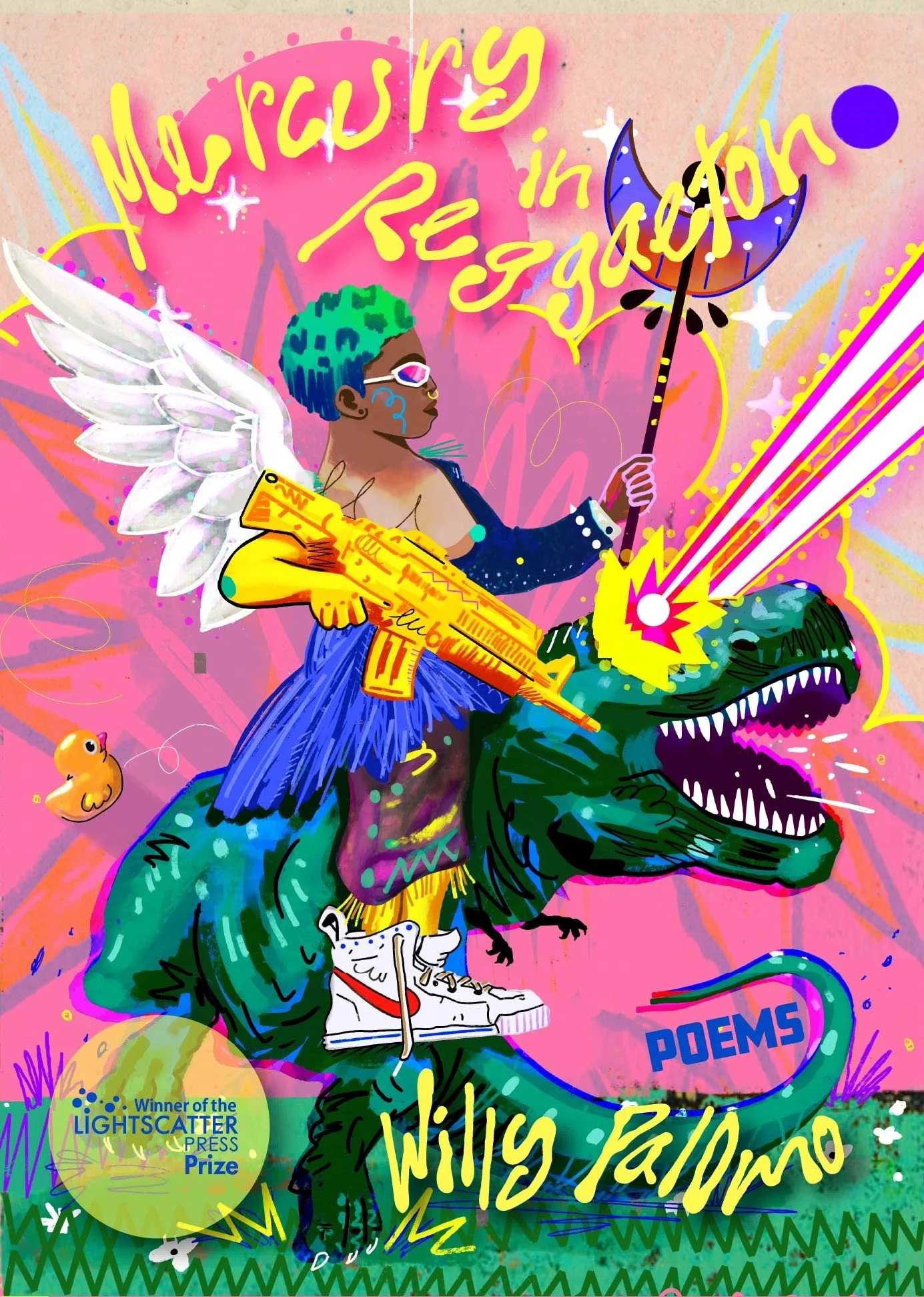
winner of the light scatter prize, 2025, Selected by Yesenia Montilla
Flanked by catastrophic headlines and somehow worse breakups, MERCURY IN REGGAETÓN indulges in sobs and perreo before facing impending doom and apocalypse. A marriage between hip-hop and the line break, between the ghazal and dembow, Palomo recounts love in a time of dystopia and resistance in a time of heartbreak.
“This poet makes of its speaker a revolution with poems like: Desktop Graffiti, Pa’ Mis Brujas and For Those Who Have Sexuality With The Wind, The Flowers, The Garden! It coaxes the spells of Haryette Mullen, Ada Límon and Walter Mercado, becoming profoundly punk and counterculture while invoking its own sense of pop. It forces us to listen to the dying patriarchy in our songs—how the music is transformed through our body into something new and achingly beautiful.”
—Yesenia Montilla, author of Muse Found in a Colonized Body
“I don’t want to leave this book. It’s dark and luminous, like the obsidian mirror that Tezcatlipoca carries in his chest, like a revived and desperate deity. Journeying through this book is, in a certain way, to piece together a broken mirror. MERCURY IN REGGAETÓN is urgent writing for the times we live in: “We were not born / to be loved but to warn all our fathers: we are the end of your era.”
—Elena Salamanca, author of Peces en la boca
Willy Palomo’s MERCURY IN REGGAETÓN is a mic soaked in blue flames. These searing poems spit a new imagination of justice on the ugly language of those who fear truth and history. Palomo offers us astonishing music, flushed by a raw reckoning that demands we believe we deserve our flawed love-songs. Powerful and vulnerable, MERCURY IN REGGAETÓN makes me want to sway on the crowded porch of memory, remembering how the sun and moon slow kiss the old-school block on its soaked, “loss-liquored” mouth. Here is a poet whose anthems bring us to our knees in a symphonic feast of pride, freedom, and revolution, “We owe no god / any more rituals / of slaughter, / no countries / the love stolen / from our chests.” Willy Palomo returns the terror of our oppressors to themselves so that we must witness and praise the urgent forces of our love and mercy.”
—Rachel Eliza Griffiths, author of Promise

“What Hip-Hop Said When I Looked in the Mirror” from MERCURY IN REGGAETÓN